Vegetating MSE Walls: Why High-Performance Hydroseeding Is the Optimal Solution
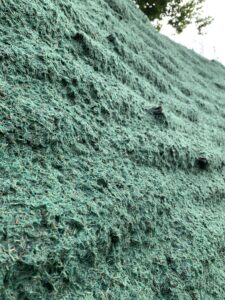
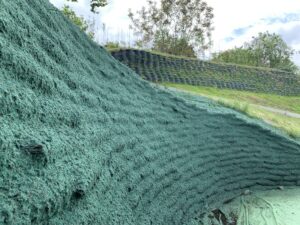
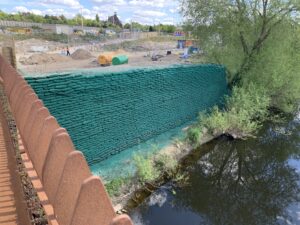
Mechanically Stabilised Earth (sometimes referred to as Mechanically Stabilised Soil) – MSE walls are a mainstay of modern civil engineering. Used extensively in highways, rail corridors, commercial developments, and environmental schemes, they provide structural stability while allowing steepened embankments and efficient land use.
The challenge is not building them — it’s vegetating them properly.
Establishing durable, uniform vegetation on MSE wall faces requires a method that can handle steep gradients, low-fines growing media, exposure, and erosion risk. This is where high-performance hydroseeding systems — particularly when using specialist hydromulches such as EarthGuard — offer a technically superior solution.
Commonly Hydroseeded MSE Walls
An MSE wall is a reinforced soil structure composed of:
- Soil filled bags
- Horizontal reinforcement (typically geogrids or steel strips)
- Wrap-around geotextile
Unlike mass concrete retaining walls, MSE systems rely on soil–reinforcement interaction to create stability. Many modern designs aim for a green or wrap-face finish, integrating vegetation into the structural façade for environmental and aesthetic benefit.
However, these faces are typically:
- Steep (often 70–90°)
- Free-draining
- Nutrient-poor
- Highly exposed to wind and solar gain
These characteristics make conventional seeding methods ineffective.
The Vegetation Challenge
Establishing vegetation on an MSE face involves overcoming several technical constraints:
- Surface Instability – The growing medium may be coarse and prone to slippage.
- Moisture Deficit – Rapid drainage reduces seed germination success.
- Erosion Risk – Rainfall can wash out seed before establishment.
- Access Limitations – Steep faces limit manual operations.
- Uniformity Requirements – Infrastructure projects demand consistent coverage.
Broadcast seeding or hand placement cannot deliver the adhesion, moisture retention, or fibre matrix necessary to secure seed on near-vertical faces.
Why Hydroseeding Is Technically Superior
Hydroseeding applies a homogenous slurry containing:
- Selected seed mix
- Specialist hydromulch
- Fertiliser
- Soil amendments
- Tackifiers (if required)
- Water
The mixture is hydraulically applied under pressure, ensuring full surface contact and uniform coverage — even on steep MSE faces.
Key technical advantages include:
- Fibre matrix encapsulation of seed
- Surface bonding to prevent wash-off
- Moisture retention enhancement
- Accelerated germination
- Improved root-to-soil contact
When paired with high-performance hydromulch, the results are significantly enhanced.
EarthGuard: A High-Performance Hydromulch Solution
EarthGuard is a specialist engineered hydromulch designed for demanding applications such as steep slopes, erosion control, and reinforced soil structures.
Its performance characteristics typically include:
- High fibre density for improved interlocking
- Enhanced bonding capability
- Superior water-holding capacity
- Resistance to rainfall impact
- Formation of a stable growth matrix
On MSE walls, this delivers three critical outcomes:
1. Immediate Surface Protection
The bonded fibre matrix shields the face from rainfall erosion during the critical establishment phase.
2. Optimised Germination Conditions
Improved moisture retention mitigates the rapid drainage associated with reinforced soil faces.
3. Structural Compatibility
The applied layer integrates with wrap-face geotextile or soil-filled facings without compromising structural performance.
Performance Benefits for Infrastructure Projects
For highways, rail, utilities, and commercial developments, vegetation is not purely aesthetic — it serves functional purposes:
- Surface erosion control
- Visual mitigation
- Habitat creation
- Compliance with environmental planning conditions
- Long-term slope stability contribution
Hydroseeding with a high-performance mulch such as EarthGuard provides:
- Rapid, even establishment
- Reduced rework and patching
- Lower lifecycle maintenance
- Reliable programme delivery
For contractors and developers, that translates directly into risk reduction and cost efficiency.
Why Specialist Application Matters
Successful MSE wall hydroseeding is not simply about product choice — it requires:
- Correct slurry calibration
- Appropriate seed selection for aspect and exposure
- Accurate application rate
- Experience in steep-face delivery
- Integration with geotechnical design intent
Specialist hydroseeding contractors with infrastructure experience such as RMB Hydroseeding understand the interplay between reinforcement systems, soil structure, and vegetation performance.
Conclusion
MSE walls are engineered structures — and their vegetative finish should be engineered with equal precision.
Hydroseeding using specialist high-performance hydromulch such as EarthGuard offers:
- Superior adhesion
- Enhanced germination
- Effective erosion control
- Reliable, uniform coverage
For modern infrastructure schemes requiring green, stable, and durable vegetated facades, it is not simply a viable method — it is the optimal one.
If you are designing, constructing, or maintaining reinforced soil structures, specifying specialist hydroseeding from the outset ensures performance, compliance, and long-term success.